
2026 Trends: Why Closed Pods Are Rising in New Zealand’s Vape Market
A Market Reshaped, Not Simplified
New Zealand’s vape industry in 2026 is undergoing a structural transition rather than a simple product “winner” scenario.
Following the removal of disposable vapes and tighter regulatory controls on retail display, marketing, and product availability, the market has not collapsed — it has reorganized itself around reusable systems.
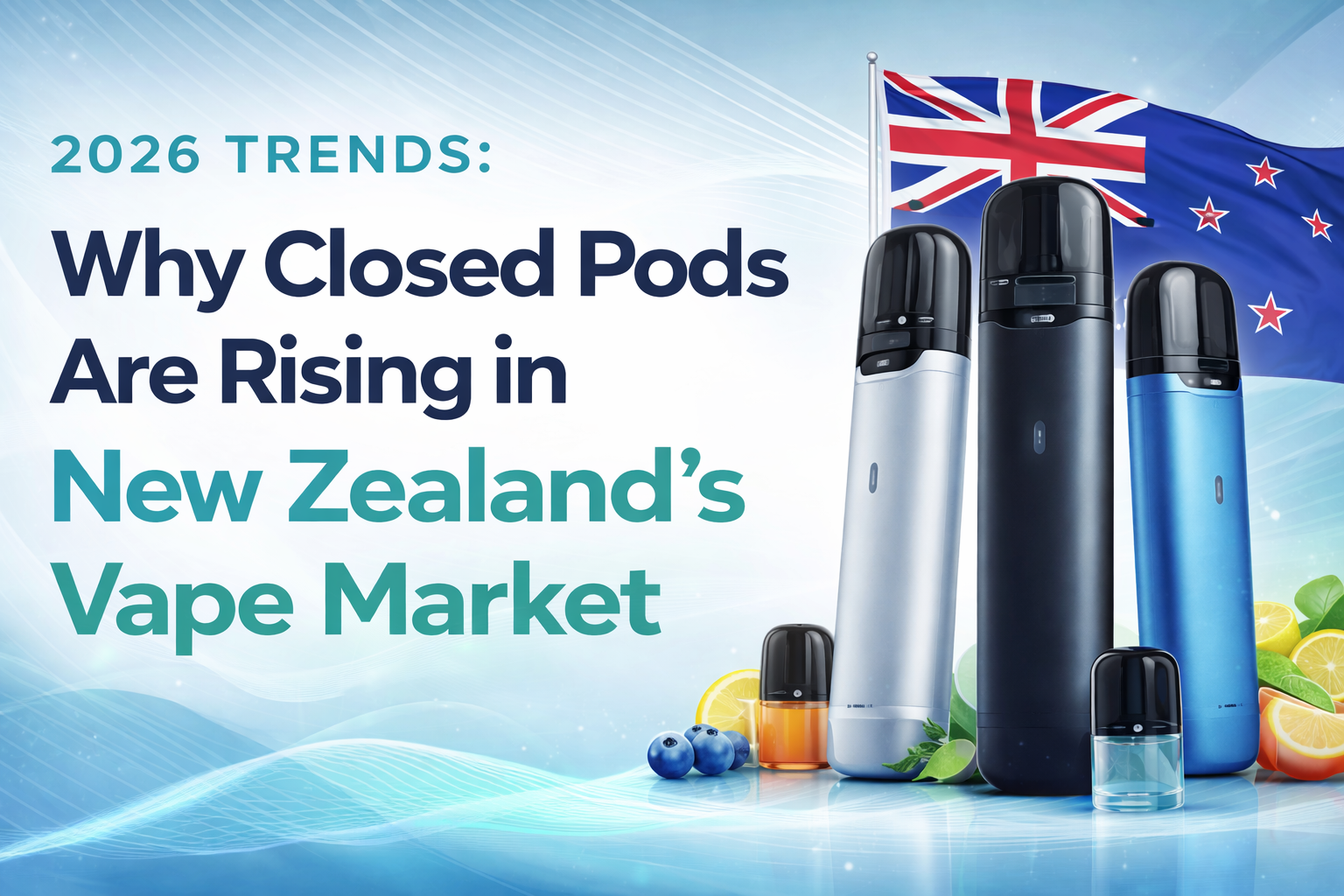
Among these, closed pod systems have emerged as one of the most widely adopted formats, particularly among users transitioning away from disposables.
However, the reality is more nuanced:
The NZ vape market is now segmented, with different device types serving different user groups rather than one format dominating all.
The Regulatory Shift That Changed Everything
The biggest catalyst behind current market behavior is regulation.
New Zealand has implemented strict controls that include:
- Removal of disposable vape products from the market
- Tight restrictions on retail display and advertising
- Limits on nicotine strength and product accessibility rules
- Stronger enforcement around youth access prevention
These changes have not eliminated vaping demand — instead, they have redirected it toward compliant, reusable alternatives.
This is where closed pod systems enter the picture.
Why Closed Pods Became the Most Accessible Replacement
Closed pod systems are not new to the market, but their relevance has increased significantly in the post-disposable environment.
They are gaining traction because they closely match what many users previously valued in disposables:
Key reasons for adoption:
- Simple, low-maintenance usage
- Pre-filled pods (no refilling required)
- Consistent performance with minimal setup
- Compact, portable device design
For many consumers, especially former disposable users, closed pods represent the closest “like-for-like” transition within the new regulatory environment.
But Closed Pods Are Not the Only Growth Segment
It is important to understand that New Zealand’s vape market is not converging into a single dominant product type.
Instead, three clear user segments are forming:
1. Transition Users (Former Disposable Consumers)
- Prefer closed pod systems
- Value convenience and simplicity
- Want minimal learning curve
2. Experienced Users
- Prefer open or refillable systems
- Focus on customization, coil choice, and cost efficiency
- Less influenced by disposables historically
3. Hybrid Users
- Use pod-mod systems or switch depending on context
- Balance convenience with flexibility
👉 This segmentation is key: closed pods are growing, but they are not replacing all other formats.
Retail Environment: Why Simplicity Wins Under Restriction
New Zealand’s retail vape environment has become highly controlled:
- Products cannot be freely displayed
- Marketing visibility is limited
- In-store education is more important than visual branding
In this context, closed pod systems perform well because they are:
- Easy to explain quickly (“insert pod and use”)
- Low-friction at point of sale
- Less complex than open systems
For retailers, simplicity directly impacts conversion rates.
However, open systems remain present because they serve a different role — not mass convenience, but experienced user retention.
Consumer Behavior in 2026: From Experimentation to Routine Use
The NZ vaping audience has matured.
Earlier phases of the market were driven by:
- experimentation
- device switching
- novelty and flavor exploration
In 2026, the dominant behavior is different:
Current user priorities:
- consistency over novelty
- convenience over customization (for mainstream users)
- discreet, portable usage
- predictable performance
Closed pods align strongly with these expectations — but primarily within the mainstream user group, not the entire market.
The Role of Open Systems: Still Relevant, Just More Specialized
Open and refillable systems are often misunderstood as “losing” in simplified narratives.
In reality, they remain:
- cost-efficient for long-term users
- preferred by experienced vapers
- important for flavor customization
- widely used in specialty retail channels
Their role has not disappeared — it has narrowed into a more experienced segment of the market.
The Real Market Shift: Consolidation, Not Replacement
The most accurate way to describe NZ’s vape landscape in 2026 is:
The market is consolidating around reusable systems after disposable removal, not converging on a single dominant device type.
Within that consolidation:
- Closed pods are becoming the most accessible mainstream entry point
- Open systems remain strong in advanced user segments
- Hybrid devices continue to bridge both needs
This is not a “winner-takes-all” shift — it is a restructuring of user pathways.
What This Means for Brands and Retailers
For companies operating in the NZ market, the implications are clear:
Product strategy:
- Closed pod systems should prioritize ease-of-use and reliability
- Open systems should focus on performance and longevity
Market positioning:
- Avoid one-size-fits-all messaging
- Segment communication by user experience level
Growth focus:
- Transition users (from disposables) are the largest growth opportunity
- Retention in open-system users remains highly valuable
A Market Defined by Segmentation, Not Dominance
New Zealand’s vape industry in 2026 is not being led by a single product category.
Instead, it is defined by regulation-driven segmentation and user migration patterns.
Closed pod systems are rising because they:
- align with regulatory structure
- match the needs of transitioning users
- fit the constraints of modern retail environments
But they exist alongside other stable categories that continue to serve different user needs.
The real story is not that closed pods are “winning” —
it’s that they have become the most natural entry point in a restructured market.