
The Complete Guide to Hybrid Pod Systems (2026 Edition)
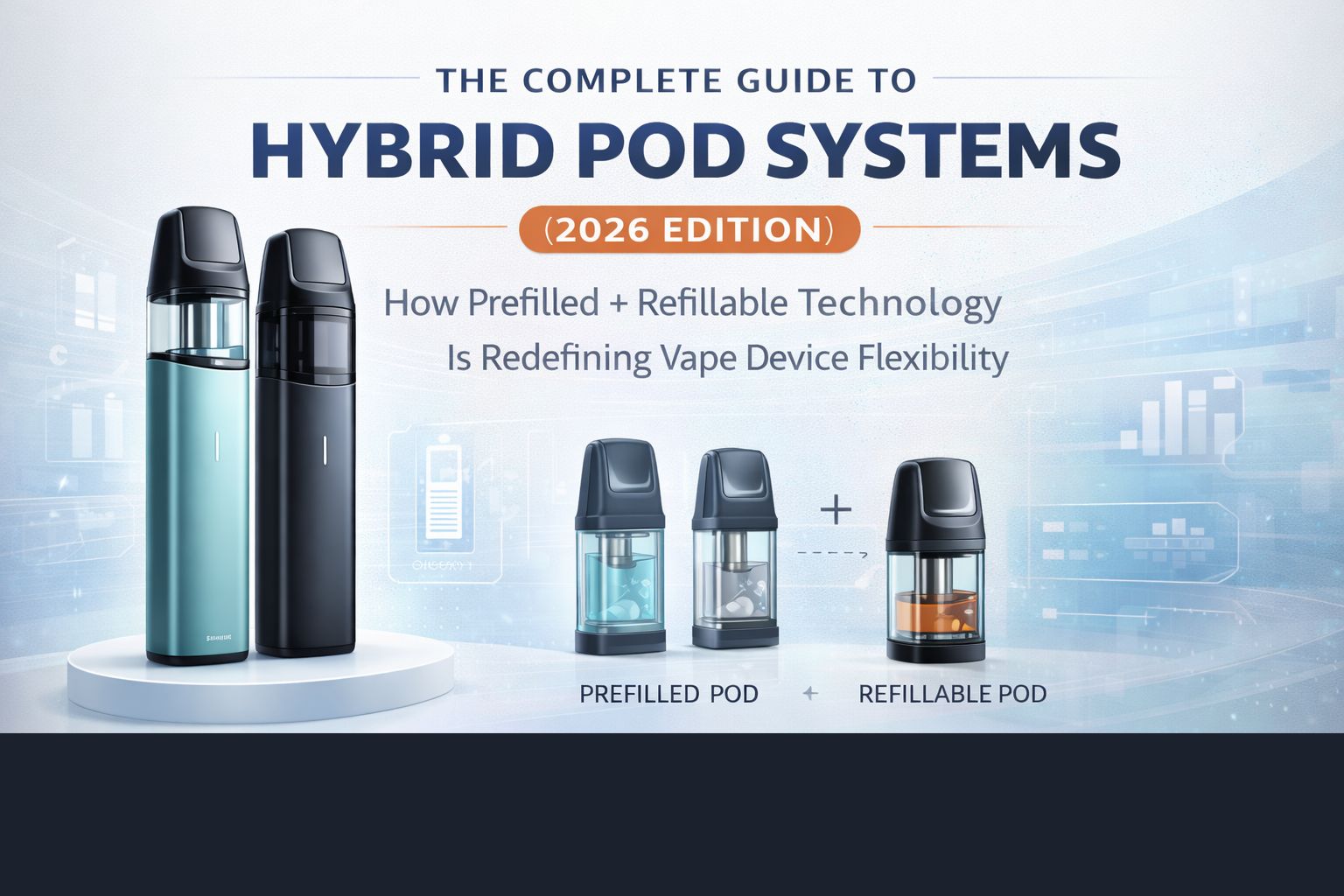
How Prefilled + Refillable Technology Is Redefining Vape Device Flexibility
The Shift Toward Flexibility
For years, the vape market has been divided into two clear categories:
- Prefilled (closed) pod systems → simple, convenient
- Refillable (open) pod systems → customizable, flexible
Both work. Both have their place.
But here’s the thing — user expectations have changed.
In 2026, that line is starting to blur.
People don’t want to choose between convenience or flexibility anymore.
They want both.
That’s exactly where hybrid pod systems come in.
👉 Hybrid Pod Systems
Devices that combine the convenience of prefilled pods with the flexibility of refillable systems.
What Is a Hybrid Pod System?
At a basic level, hybrid pod systems are straightforward:
They’re devices that support both prefilled and refillable pods within the same ecosystem.
But in practice, they represent something bigger.
They’re not just a feature upgrade — they’re a shift in how devices are designed around real user behavior.
- Quick, no-hassle usage? → Prefilled
- Want to switch flavors or optimize cost? → Refillable
Same device. Different use cases.
Why Hybrid Systems Are Gaining Momentum
This isn’t just a niche concept anymore.
You’re starting to see hybrid systems gain attention because they solve a problem that’s been sitting in plain sight for years.
The traditional categories each have limitations:
Prefilled systems are easy… but limiting
- Limited flavour options
- Higher long-term cost
- Less customization
Refillable systems are flexible… but not always convenient
- Requires more effort
- Learning curve for beginners
- Potential for leakage if poorly designed
Hybrid systems sit right in the middle
They don’t try to replace either category —
they simply remove the trade-off.
And that’s why they’re starting to resonate.
Hybrid Systems Solve This By Offering:
✔ Convenience when needed
✔ Flexibility when desired
✔ Better long-term value
✔ Wider flavor possibilities
👉 It’s not a replacement — it’s an evolution.
How Hybrid Pod Systems Work
From a user perspective, it’s simple.
From a design perspective, it’s not.
A well-built hybrid system needs to handle:
- Different pod types
- Consistent airflow across both
- Stable power output
- Reliable sealing (to prevent leaks)
At their core, hybrid systems are built around device compatibility.
Key Components:
- Battery device
- Interchangeable pod types
- Optimized airflow system
- Coil compatibility (integrated or replaceable)
User Flow:
- Use prefilled pods for quick, hassle-free experience
- Switch to refillable pods for customization
The core idea is compatibility
A single device is engineered to support:
- Prefilled pods (plug-and-play)
- Refillable pods (user-filled)
Switching between them should feel seamless — not like switching devices entirely.
When it’s done right, the experience stays consistent regardless of which pod you use.
👉 One device, multiple use cases.
Prefilled vs Refillable Pods (Quick Breakdown)
Prefilled Pods
You open it, click it in, and it works.
|
Pros: Cons: |
Best for:
But you give up:
|
Refillable Pods
You choose your liquid, refill, and go.
|
Pros: ✖ Requires refilling |
Best for:
But it comes with:
|
Hybrid Pods
You don’t choose one — you use both.
That’s the difference.
✔ Combines both advantages
✔ Adapts to user preference
✔ Flexible usage scenarios
Key Benefits of Hybrid Pod Systems
Where Hybrid Systems Actually Make Sense (Real Use Cases)
This is where it clicks for most people.
1. Flexibility Without Compromise
Users are no longer locked into one system.
- Quick use → prefilled
- Custom use → refillable
2. Better Value Over Time
New users start with prefilled.
As they get comfortable, they move into refillable.
No need to change devices.
👉 Reduces long-term cost while maintaining convenience.
3. Broader Flavour Access
- Predefined flavours via prefilled pods
- Unlimited variety via refillable
4. Simplified User Journey
Hybrid systems support:
- Beginners → easy onboarding
- Experienced users → deeper control
5. Reduced Product Switching
Instead of buying multiple devices:
👉 One system does both
Who Are Hybrid Pod Systems For?
1. New Users
- Start simple with prefilled pods
- Transition when ready
2. Experienced Users
- Want flexibility without carrying multiple devices
3. Retail Customers
- Prefer options without complexity
4. Value-Conscious Buyers
- Looking for long-term efficiency
Retail & Distributor Perspective: Why This Category Matters
Why Retailers Should Be Paying Attention
From a retail perspective, this category is more interesting than it looks at first glance.
Hybrid pod systems are not just a product innovation — they are a retail opportunity.
1. Higher Customer Retention
- Users stay within one ecosystem
- Repeat purchases across both pod types
2. Increased Basket Size
- Device + prefilled pods + refillable pods + e-liquid
3. Product Differentiation
- Less crowded than disposable category
- More premium positioning
4. Future-Proof Inventory
- Adapts to changing consumer behavior
- Aligns with evolving regulations
Design & Engineering Challenges
This is where things get real.
Hybrid systems sound great on paper —
but they’re harder to execute than most people think.
Hybrid systems are more complex to design.
Key Challenges:
- Ensuring pod compatibility
- Maintaining consistent airflow
- Preventing leakage across pod types
- Balancing power output
👉 This is where product quality separates brands.
Common issues in poorly designed systems:
- Inconsistent draw between pod types
- Leakage when switching formats
- Weak performance in one mode
- Poor battery optimization
What defines a good hybrid system:
- Balanced airflow across pods
- Reliable sealing design
- Consistent power delivery
- Smooth transition between formats
👉 This is where engineering matters more than marketing.
How Hybrid Pod Systems Fit Into Market Trends
If you zoom out, this isn’t happening in isolation.
Hybrid pod systems align with several bigger trends:
1. Shift Away from Single-Use Products
- Sustainability pressure increasing
2. Demand for Flexibility
- Users want more control
3. Regulatory Pressure
- Some markets restricting disposables
4. Premiumization of Devices
- Consumers willing to pay for better systems
👉 Hybrid systems align with all four trends.
So… Are Hybrid Pod Systems the Future?
They may not replace every category — but they are positioned to:
✔ Bridge the gap between systems
✔ Offer a more adaptable solution
✔ Create a new standard for flexibility
How to Choose a Good Hybrid Pod System
What to Look for in a Hybrid Pod Device
If you’re evaluating one — whether as a user or a retailer — keep it simple.
Look For:
✔ Strong device compatibility
✔ Leak-resistant design
✔ Consistent airflow
✔ High-quality coil systems
✔ Reliable battery performance
Avoid:
✖ Poorly designed interchangeable pods
✖ Inconsistent performance across modes
✖ Weak build quality
The future of vaping isn’t about choosing between convenience and control.
It’s about having both — when you need it.
Hybrid pod systems represent a shift toward:
- Smarter design
- Better user experience
- More adaptable products
Because the next generation of devices won’t limit users —
they’ll adapt to them.
If you’re evaluating where the market is heading, hybrid systems aren’t just another category — they’re a signal.
A shift toward flexibility, efficiency, and smarter design.
Not because they replace what exists —
but because they make it work better.
Connect with the team to explore how hybrid pod systems can fit into your product lineup and retail strategy.